
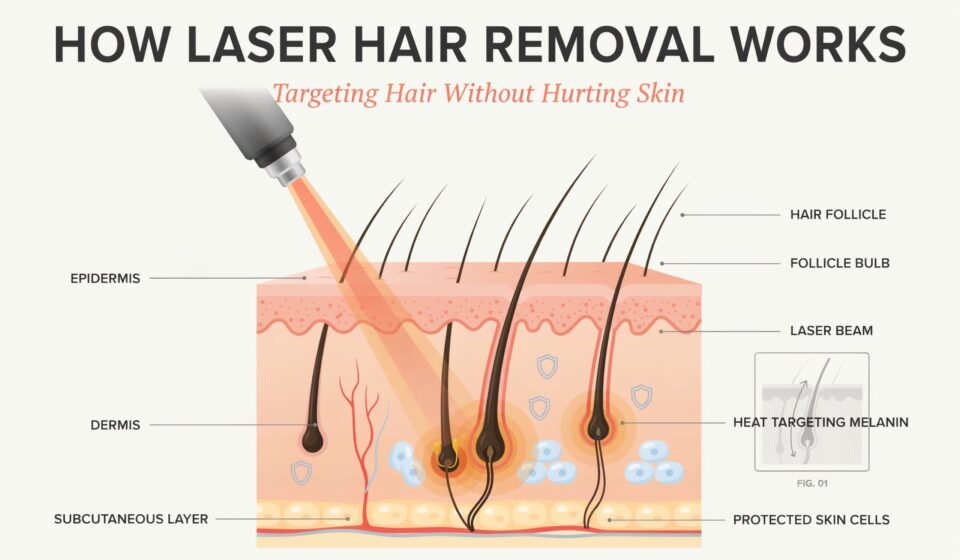
Many people wonder how a beam of light can remove hair without damaging the surrounding skin. The answer lies in how a laser hair removal machine works. It sends focused light energy into the skin, where the hair absorbs most of that energy. Because hair responds differently from surrounding skin, the treatment can target unwanted hair while helping to protect nearby tissue.
Modern devices are designed for safe laser hair removal by carefully controlling energy levels, pulse timing, and cooling features. In this article, we will explain how the laser targets hair follicles, why skin stays protected, and how newer technologies make treatments safer for different skin types.
What Makes Laser Light Go Toward Hair Instead of Skin?
Lasers target melanin, the pigment usually found in higher amounts in hair than in the surrounding skin. Because of this difference, the hair absorbs more laser energy. Think of melanin as a sponge for light — hair soaks up more energy than skin. Some devices use melanin concentration detection to help adjust settings for different skin and hair types.
This process is called selective heat absorption, meaning the hair takes in more energy than nearby tissue. Another term, chromophore targeting, describes how the laser focuses on melanin. During optical energy transfer, the absorbed light changes into heat inside the hair shaft and root. This is how a laser targets hair follicles while protecting nearby skin.
How Does Heat Stop Hair Growth Without Burning the Surface?
The treatment works through thermal energy targeting, where laser energy travels down the hair shaft and reaches the follicle beneath the skin. The heat weakens the structures responsible for future hair growth.
The term follicle heat destruction may sound harsh, but it simply means heating the follicle’s growth center enough to reduce its ability to produce hair. Hair grows in stages, which is why hair growth cycle targeting is important.
Treatments work best during the active growth phase when more pigment is present. Multiple sessions are often needed, and modern devices use safe laser hair removal technology to balance effectiveness with skin safety.
Why Does the Right Wavelength Matter for Skin Safety?
Different laser systems use different wavelengths, and each reaches a specific depth beneath the skin. This is called wavelength penetration depth. The goal is to deliver energy to the hair follicle while limiting heat in the skin’s upper layers.
A key part of this process is epidermis protection, which helps keep the outer skin layer safe during treatment. Skin tone, hair color, and hair thickness all influence which wavelength is chosen. This level of treatment precision control allows providers to customize treatments and use safe laser hair removal technology more effectively for different individuals.
How Do Cooling Systems Help Protect Sensitive Skin?
Cooling is an important part of laser hair removal skin protection. Many modern devices use cooling tip technology to cool the skin before, during, or immediately after each laser pulse. This helps reduce surface heat while allowing laser energy to reach the hair follicle below.
Advanced skin cooling systems improve comfort and help protect the skin’s outer layer from excessive heat. For laser hair removal for sensitive skin, cooling becomes especially valuable. Some people may require lower energy settings, longer spacing between sessions, or additional comfort measures. Modern contact cooling mechanisms assist with skin sensitivity management, helping treatments remain comfortable while maintaining effectiveness.
What Do Pulse Duration and Energy Settings Do?
Laser treatments do not use continuous light. Instead, they deliver energy in short bursts. Pulse duration control refers to how long each burst of light lasts. Shorter or longer pulses can be selected based on hair thickness, color, and skin type.
Another important setting is energy fluence adjustment, which controls the strength of each pulse. The goal is to provide enough heat to affect the hair follicle without overheating the skin.
Many devices also use laser pulse modulation to deliver energy more evenly across the treatment area. In addition, thermal diffusion control helps prevent heat from spreading too far beyond the follicle.
These features improve surrounding tissue protection and allow treatments to be safely customized for different skin tones and hair types.
Is Laser Hair Removal Non-Invasive and Safe for Most Skin Types?
Non invasive laser hair removal works from outside the skin. Unlike procedures that cut, puncture, or remove tissue, laser treatments rely entirely on light energy.
For most people, safe laser hair removal depends on proper device selection, accurate settings, and professional treatment planning. Skin tone and hair color play a major role because both contain pigment that can absorb laser energy.
People seeking laser hair removal for sensitive skin or those with darker skin tones may need customized settings. Proper treatment planning supports surrounding tissue protection while effectively targeting unwanted hair growth.
Why Does the Laser Focus on Hair So Well?
Laser hair removal works because hair pigment absorbs light more effectively than the surrounding skin. That light becomes heat, which weakens the follicle and helps reduce future hair growth. Modern systems improve safe laser hair removal through wavelength selection, pulse control, cooling features, and energy adjustments.
These features improve laser hair removal skin protection while keeping treatments precise and comfortable. When the right settings are used, laser hair removal can be a careful way to reduce unwanted hair while helping protect the skin around it.